


March Madness is Internationalization in Real Time
- Timothy F. Bryson

- Apr 1
- 10 min read
This piece was written in April 2026. It is part of a larger body of work I am building at the intersection of internationalization, college athletics, and sports diplomacy. The landscape will keep shifting. I will keep writing. For speaking, consulting, or research inquiries, reach out at WalkWithTFB@gmail.com.
Every March, the college sport world waits for Selection Sunday.
Who is in the tournament? Who is out?
Which 5-12 matchup is going to deliver the upset of the year?
Which double digit seed is most poised to make a run to the Final Four?
And every year, more people are also paying attention to the growing number of international athletes competing in the NCAA tournament.
After the women’s and men’s brackets were released, news outlets and organizations from around the world began posting how many athletes were not from the United States.
I even shared how international athletes were a competitive advantage and highlighted the overrepresentation of international athletes in the Final Fours.
But that was just the beginning.
Because the real story is not simply that international athletes are here and competing in a billion dollar tournament.
The real story is how they got here, why they keep coming, and what their presence reveals about the evolving relationship between internationalization and college sport.
March Madness is no longer just a national event with global presence.
It is a global event staged through U.S. college sport.
Let’s walk.
Numbers Don’t Lie
In 2025, the NCAA reported 264 international student-athletes in the Division I men’s and women’s basketball tournaments. More broadly, the number of international student-athletes in Division I men’s and women’s basketball rose from 668 in 2009-10 to 1,839 in 2024-25.
That’s a 175.15% increase in international basketball athlete enrollment.
But a lot has happened in the last 15 years, so let’s look at more recent data.
FIBA is tracking international athletes in the NCAA through their annual migration report.
The graph below shows a steady increase in international athlete enrollment despite two seasons marked by a U.S. presidential election and COVID-19 pandemic. Since 2020-2021 season, the number of men’s international athletes have increased 61.46%, while women international athlete enrollment has increased 17%.
Between the last two seasons, international basketball athlete enrollment increased 11.1%.
“We are also pleased with the growth of the domestic leagues in Europe and Latin America, while we maintain our focus on the flows of young players to the NCAA.” - FIBA Secretary General Andreas Zagklis

This is not a trend. This is the shift happening in college sport.
March Madness is part of a larger basketball global ecosystem.
Which is why I believe this moment should not be reduced to a simple player count.
The better question is...
What infrastructures and pathways are producing this moment?
I see at least three relevant to this sport.
Pathway #1: National Basketball Association (NBA)
For years, the NBA has invested in identifying and developing talent outside the United States through a deliberate, multi-pronged internationalization strategy. The most visible piece of that strategy has been the NBA Academy program, a residential, year-round development center built to identify players early, place them in high-level environments, and connect them to broader basketball opportunity structures. I was fortunate to visit NBA Academy Africa and saw firsthand how this is structured.
At its peak, the Academy program ran three residential hubs: NBA Academy Africa in Senegal, NBA Global Academy in Australia, and NBA Academy Latin America in Mexico. Each was designed to serve a distinct region of the global talent landscape. Together, they produced players who changed the trajectory of the draft. Josh Giddey, Dyson Daniels, and Bennedict Mathurin came through the Australia program. Khaman Maluach, drafted 10th overall in the 2025 NBA Draft, came through the Africa program.
These are not just outcomes. These are lottery picks.
In July 2025, the NBA closed the Global Academy and Latin America Academy as part of a strategic restructuring. The decision reflected a shift in priorities toward larger, nontraditional basketball markets in Asia and the Middle East that the league sees as essential for its long-term global growth. NBA Academy Africa in Senegal remains intact. The new NBA Global Academy will launch in Abu Dhabi as part of a long-term partnership with the UAE.
The footprint is evolving. The commitment to building international pipelines is not.
The Academy program's reach into March Madness is documented. More than 100 NBA Academy athletes have committed to or gone on to attend NCAA Division I schools. When those players show up in the tournament, they are not only success stories. They are outcomes.
But the men's pipeline is only part of the story.
The NBA Academy Women's Program launched in 2018 with an explicit mission: create development pathways for elite international female prospects that didn't exist before. Since inception, 45 participants have gone on to play at the Division I level. Three have signed professional contracts. Han Xu became the first program alum drafted into the WNBA in 2019. The program runs camps, virtual development cohorts, and scouting networks that span dozens of countries. At the 2024 Basketball Without Borders women's camp, 34 campers received NCAA Division I scholarship offers.
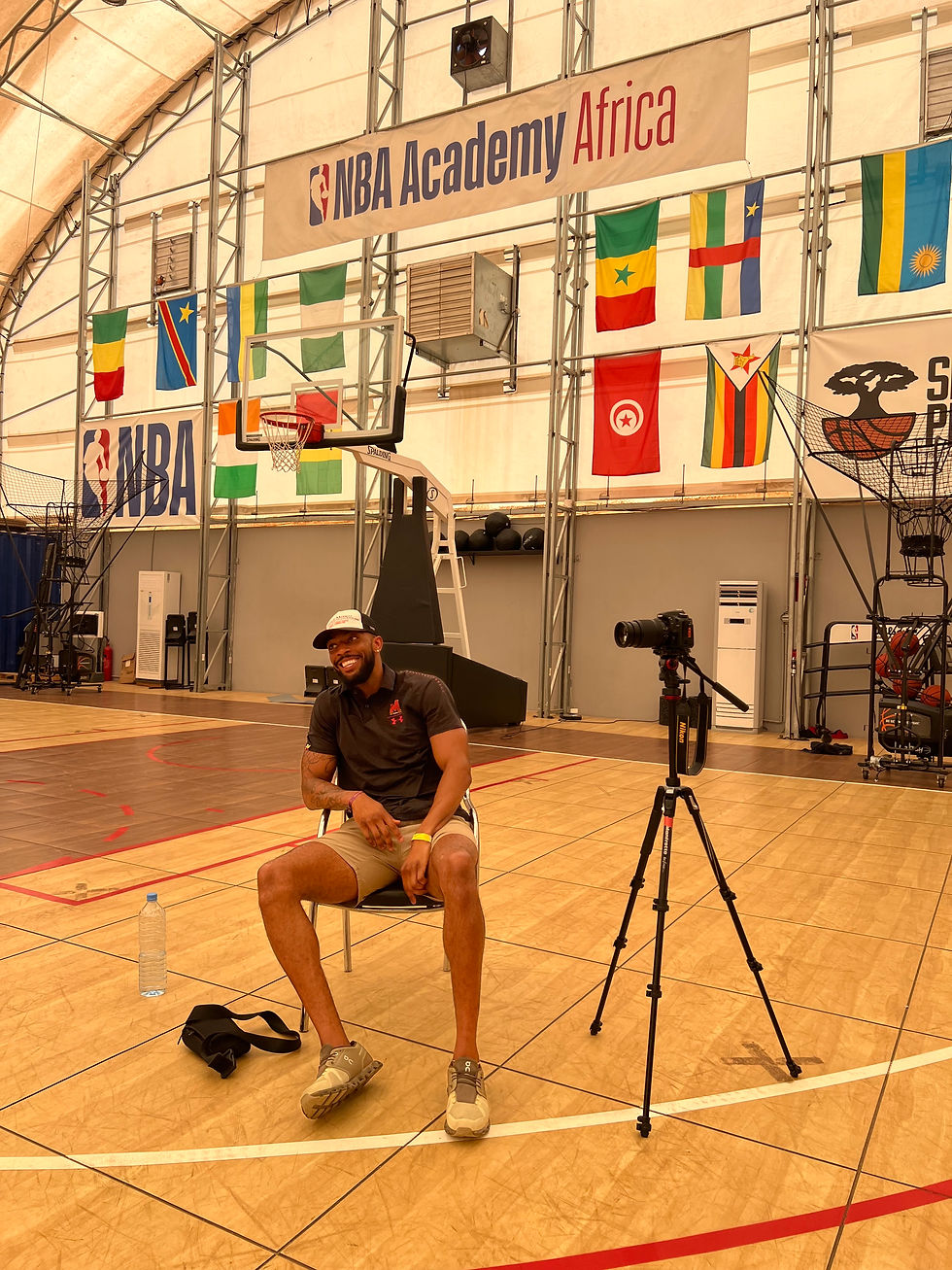
Basketball Without Borders, the NBA and FIBA's joint global development program launched in 2001, has reached more than 4,600 participants from 149 countries and territories. It functions as the front door of the entire NBA development ecosystem, where many international players are first seen, evaluated, and connected to opportunities.
So when March Madness arrives and 48 NBA Academy and BWB alumni are in both the men's and women's brackets, we are not simply watching a college tournament. We are watching the visible results of a transnational player development model that spans continents, genders, and decades of institutional investment. It’s a model the NBA has been cultivating for years.
Pathway #2: Non-Profit Organizations
While the NBA has global infrastructure and resources to match, a parallel pipeline has been built on much smaller budgetsNonprofit organizations across Africa have been doing the foundational work of identifying players, developing them holistically, and connecting them to the global basketball system long before anyone was tracking their alumni in a March Madness bracket.
Giants of Africa. Founded by former Toronto Raptors president Masai Ujiri, runs development camps across the continent with a straightforward premise: the talent is there, the infrastructure is not. Giants of Africa builds courts, runs free camps, and creates visibility for players who would otherwise be invisible to the global recruiting system. Ujiri has leveraged his NBA and personal network to fund equipment, build facilities in countries like Kenya, and bring African players into rooms they would not have access to enter. Several Giants of Africa alumni have gone on to receive NCAA Division I offers. But more importantly, the organization has changed what is possible in the imagination of young players across the continent.
Hoops4Hope. Based in South Africa, operates at the intersection of basketball and community development. It uses the game as a vehicle for creating competitive exposure and structural visibility for players in a region where barriers to NCAA access are high. While much of the nonprofit basketball development conversation centers on West Africa, Hoops4Hope is a reminder that the pipeline is continental. Southern Africa is producing talent too, and organizations like this one are the reason that talent gets seen and recruited.
Educational Basketball Nigeria. Emmanuel Okorafor came through this program before signing with the NBA Academy and eventually landing at Louisville. Emmanuel Ogbole, another product of the same organization, drew offers from Seton Hall and Rutgers. Educational Basketball Nigeria has built something intentional in a country that is now one of the most significant exporters of basketball talent to the NCAA.
NDAW Academie. Founded in 2022 by Colin Lamine Ndaw a Senegalese-born sophomore guard currently playing Division I basketball at William and Mary. NDAW Academie runs camps, clinics, and court rehabilitation programs across nine communities in Senegal. Ndaw came through this pipeline himself, recruited from Senegal to IMG Academy on scholarship before signing with William and Mary, and is now building the infrastructure back home that gave him his shot. NDAW Academie is only a few years old and is already creating generational impact. I am confident we will see Colin and NDAW Academie alumni in future March Madness tournaments.

Pathway #3: Country Sport Federations
While nonprofit organizations represent the community-level infrastructure of international player development, national sport federations represent the institutional infrastructure. And no federation has produced a more dramatic impact on the NCAA landscape than Canada Basketball.
Thirty-six Canadians were rostered by men’s and women’s teams competing in the 2026 tournament, up from 20 the previous year and shattering the record of 30 set in 2022.
Canada Basketball built this through a integrated development model that starts with grassroots programming and runs all the way through national team competition. The emergence of the Ontario Scholastic Basketball Association provided one pathway to keep top Canadian players in the country for high school while still preparing them for the NCAA level. The implementation of structured development programs, elite academies, and sustained investment in coaching infrastructure transformed Canada into one of the most productive sources of basketball talent in the world.
Canada offers one of the clearest examples of what federation-level intentionality looks like. Canada Basketball’s 2025-28 strategic plan centers a vision of becoming “Best In the World” and “Best For Canada.” That national ambition has also been backed by public investment. In 2022, the Government of Canada announced $5.6 million in funding for Canada Basketball and Wheelchair Basketball Canada to support operations, athlete development, and safer training environments. Canadian players on NCAA rosters reflects federation leadership, long-term planning, and national investment in the sport.

The national team has been a critical piece of this. When players like Agot Makeer, Zach Edey, Toby Fournier, and Ryan Nembhard wear Canada’s jersey in international competition before they ever play in NCAA competition, they are being developed. They are playing against professional competition and learning how to perform on a global stage. As a result, they are arriving at their NCAA programs more complete and ready to provide immediate impact.
Michael Meeks, men’s youth development manager for Canada Basketball, has called the recent surge a sign of things to come. He shared that the basketball environment is still in its infancy and that there are so many things the system can still do better in terms of resources, financial infrastructure, and opportunities like professional paid jobs for coaches and trainers.
Architecture is driving Canada’s basketball rise. Canada made a long-term commitment to building the system, while also celebrating the growth along the way.
March Madness is where that investment becomes visible to the rest of the world.
And the impact shows up in unexpected places.
In 2026, Long Island University made their first NCAA Tournament appearance as the unified LIU Sharks and no team in the entire field had more Canadian players. Five Canadians anchored their roster, including former Toronto Central Tech Blues teammates Jamal Fuller and Malachi Davis, who described LIU's Brooklyn environment as feeling like a second home to Toronto. But the Canadian presence at LIU goes beyond the players. Dalmar Ali, a Toronto native and one of the first Somali-Canadians to coach in the NCAA, serves as an assistant coach for the LIU Sharks and was recently named head coach of the Somalia Men's National Basketball Team.
One program. Five Canadian players. A Toronto-born Somali-Canadian assistant coach building an international career from Brooklyn.
Bravo, Canada.
Great, so now what.
These three pathways help explain how March Madness embodies internationalization through college sport.
International athletes are not just appearing in the bracket as isolated success stories.
They are arriving through systems.
Through league investment.
Through nonprofit intervention.
Through national federation strategy.
Through transnational circuits of identification, development, movement, and opportunity.
That is the how.
The why is connected to the transformation of college sport itself.
U.S. colleges and universities have become central actors in the global movement of sport labor talent. They offer elite competition, national exposure, degrees, professional visibility, and increasingly, access to a more commercialized and professionalized sports environment.
For many international athletes and their families, college sport represents education, mobility, and possibility. For institutions, international athletes bring talent, reach, and competitive advantage.
March Madness is not just showcasing basketball.
March Madness is showcasing how higher education and sport now operate together in a global marketplace.
It is also worth naming what these pathways have in common beyond infrastructure.
Two of the three are explicitly centered on Africa. The third (Canada) is disproportionately producing Black athletes from African diasporic communities, players whose journeys to NCAA rosters are shaped by histories, cultures, and community ties that connect back to the continent.
The global movement of basketball talent into American college sport is a story about Black and immigrant labor moving through systems not designed with their identity in mind.
This tension sits at the center of my research agenda and forthcoming dissertation.
But let’s keep it 100.
Because for every legitimate pathway that athletes choose, there is also an ecosystem of recruiting services, unregulated agents, and bad actors operating in the same space. The same global demand that drives institutional investment also creates conditions for exploitation. Young athletes and their families, navigating unfamiliar systems in unfamiliar countries, are vulnerable. And the pipeline nor F-1 visa does not always protect them.
Javier Wallace, PhD names it directly in his book Basketball Trafficking: Stolen Black Panamanian Dreams.
His work follows a Black Panamanian athlete through a pipeline shaped by exploitation where migration, race, education, sport, and immigration status collide in ways that serve institutions and agents far more than they serve the athlete. Wallace’s framing of basketball trafficking is not hyperbole.
It is a precise call out of what happens when internationalization operates without accountability, without protection, and without justice at the center.
So here we are.
As the talent pool grows, the support infrastructure must grow with it.
Colleges and universities cannot continue to celebrate internationalization in recruiting, branding, and competition while treating international athlete development as an afterthought. The NCAA’s International Student-Athlete Handbook shows us that tailored support is needed.
But a handbook is not a system.
International athletes need intentional, sustained support around ongoing transition, belonging, academic and career pathways, immigration realities, and life after competition.
Not as a supplement to the college athlete experience. As a core part of it.
The three pathways I outlined above is building pathways for these athletes to matriculate into U.S. higher education. The question now is whether American colleges and universities are willing to build the infrastructure to truly receive and take care of them.
Because we do this work for the athletes, right?
Every college athletics department needs an internationalization strategy.
It’s happening. We walking!!
Future Dr. TFB
Walk With TFB specializes in international athlete development, internationalization strategy, and sports diplomacy. We support international athletes across their full journey, from recruitment through career readiness. We also help institutions build comprehensive, values-aligned strategies for global engagement.
If your athletic department or institution is navigating international athlete support, developing global partnerships, or sport-based diplomacy initiatives, let's talk.


Comments